Paper Review: OctoMap - 3D mapping framework based on octrees
In One Line
This paper1 attempts to efficiently build a probabilistic 3D occupancy map using the octree data structure
Review
The key characteristics that contribute to the efficiency of OctoMap are noted below:
-
Volumetric Model It implements an occupancy grid mapping approach based on an octree.
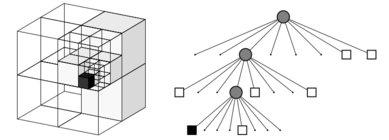 Fig 1: Octree storing free (shaded white), occupied (shaded black) and unexplored (dots) cells
 -
Probabilistic Sensor Fusion Model
represents the probability of leaf node to be occupied given sensor measurements We introduce the log-odds notation and assume a uniform prior
This allows us to simplify the update equation as follows
-
Clamping the Update Policy This enables the map to adapt to dynamic changes in the environment.
-
Tree pruning If all children of an inner node of the octree are known to have the same occupancy probability, the children are pruned. This is lossless as the parent still contains the occupancy probability value. Tree pruning, carried out recursively, drastically reduces memory utilisation and speeds up map updates.